



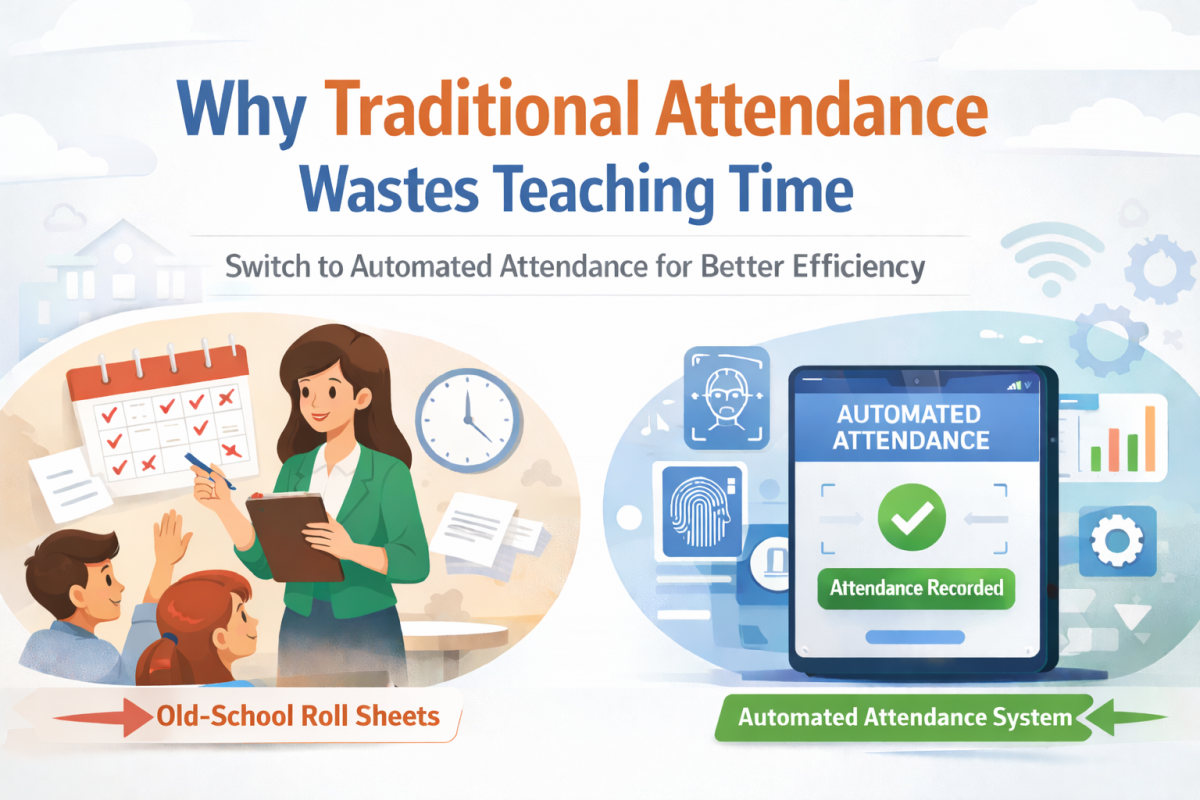
In most schools and colleges, attendance is still taken the traditional way by calling out names, marking registers, or signing sheets. While this method has been used for decades, it consumes valuable teaching time and reduces classroom efficiency. In today’s fast-paced academic environment, every minute matters.
Let’s explore why traditional attendance systems waste teaching time and why it’s time to switch to automated attendance.
1. Valuable Lecture Time Is Lost Daily
A teacher typically spends 5–15 minutes per class taking attendance manually. In institutions with multiple periods per day, this adds up significantly.
Example:
- 10 minutes per class
- 5 classes per day
- 50 minutes lost daily
Over a month, this can translate into hours of lost instructional time. Time that could have been used for concept clarification, doubt-solving, or interactive learning.
2. Interrupts Teaching Flow
Manual attendance breaks the rhythm of the class. Just as students settle into learning mode, the teacher pauses to call out names.
This interruption affects:
- Student concentration
- Classroom engagement
- Lesson continuity
Learning works best when there are no unnecessary disruptions.
3. Encourages Proxy Attendance
Traditional roll-call systems make it easy for students to answer on behalf of absent classmates.
This results in:
- Inaccurate records
- Reduced discipline
- Lack of accountability
Teachers often spend extra time verifying attendance later, adding more administrative work.
4. Administrative Overload for Teachers
Manual attendance doesn’t end in the classroom. Teachers must:
- Enter data into software
- Calculate attendance percentages
- Prepare monthly reports
This repetitive process consumes hours outside teaching time.
5. Prone to Errors
Paper registers and manual entries can lead to:
- Missed markings
- Wrong calculations
- Duplicate entries
Correcting these mistakes takes even more time and effort.
Why It’s Time to Switch to Automated Attendance
To solve these challenges, institutions are increasingly moving toward automated attendance systems.
1. Saves Teaching Time
Automated systems mark attendance instantly often within seconds without interrupting the class. This allows teachers to use the full lecture time for teaching.
2. Improves Accuracy
AI-based or biometric systems eliminate proxy attendance and reduce manual errors, ensuring reliable and tamper-proof records.
3. Real-Time Data & Reports
Automated attendance provides:
- Instant dashboards
- Absentee alerts
- Attendance percentage tracking
- Easy report generation
Administrators and teachers can monitor attendance anytime without manual calculations.
4. Reduces Administrative Burden
With automation:
- No manual registers
- No repeated data entry
- No monthly attendance calculations
Teachers can focus more on student engagement and lesson quality.
5. Scalable for Large Institutions
Whether it’s a classroom of 30 students or a university with thousands, automated systems handle attendance efficiently without increasing workload.
The Bigger Impact on Learning
When attendance becomes automatic:
- Classes start on time
- Teaching flow remains uninterrupted
- Teachers gain extra instructional minutes
- Students receive better academic focus
Even saving 10 minutes per class can significantly improve learning outcomes over an academic year.
Conclusion
Traditional classroom attendance methods may seem harmless, but they quietly waste valuable teaching time every single day. In modern education, efficiency and accuracy are essential.
Switching to automated attendance is not just about technology it’s about giving teachers back their time and improving the overall learning experience.



Comments
Loading comments...